
This is 5-Minute Kanji, and today, we will go over a chill kanji: the kanji for tree or wood.
Mnemonic:
I’m just going to KEEp drinking my MOCHA on top of this TREE.
Onyomi:
モク、ボク
moku, boku
Kunyomi:
き、こ-
ki, ko-
The kanji 木 is another basic kanji that doesn’t take much imagination to see where it came from. It essentially resembles a pine tree with a strange horizontal branch at the top. It is most commonly used to talk about trees, using the kunyomi,
The second most common reading is the onyomi, which you would use to talk about other things like the day of the week, 木よう日, Thursday. It is also used to refer to wood or lumber, the material, 木材もくざい or 木製もくせい, made from wood. Neither of these words will appear on the N5 test, though.




Rarely, you will see the other kunyomi, こ-. It is only used as a prefix in a few words. The two most common are 木立, a grove or small stand of trees, and 木戸, an old-style wooden gate. Neither of these is commonly used, though.
The other onyomi, ボク, is used exclusively in proper names of places and people. You may never see this reading ‘in the wild’.
When thinking of a mnemonic, you probably only need to focus on the two main readings – き and モク.
Mnemonic Factory
Look at me mom!
We are dealing with another pretty basic-looking kanji here – 木. If you squint, you can see a tree. Kind of a weird-looking tree with a hat, but it’s still a tree. I think of this as a Christmas tree with a little platform on top for some reason. However, you can also think of the horizontal line as the soil line, and the diagonal lines extending from the center are roots.
Let’s work on some possible English words that have similar sounds. For the most common
For the most common onyomi モク, we can use MOCHA, or the strange combinations of MOat KUruise (moat cruise, like around a castle) or MOw COO, like you are mowing and cooing at the same time? You may have also seen the ‘sound effect’ in Japanese manga – MOKUMOKU, which is used to describe the billowing of smoke.
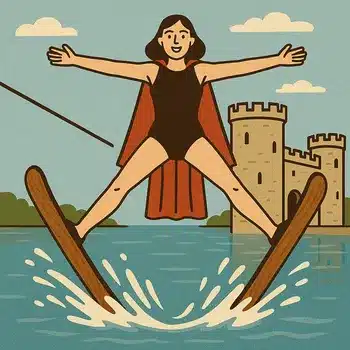
We also have き for the kunyomi, which is much easier to come up with words for. There is KEY, KEEN, KItchen, tricKY, and sKI. So, putting it all together, we could imagine someone MOwing and COOing to his beloved and passing by a funky-looking tree with a hat. He is trying to win the KEY to her heart. Or, how about imagining someone water sKIing on a MOat KUruise around a castle. As she makes her jump, she spreads out like a starfish to make a 木 shape. Of course, the horizontal line is missing, but maybe you can imagine her with a cape?
Example Words
How about a few example words where this kanji is used?
Onyomi
Let’s take a look at some of the most common words that use 木:
- 木(き) “tree”
- 木の実(きのみ) “tree seed”*
*Not an N5 word
Kunyomi
Let’s take a look at some of the most common words that use 月:
- 木よう日(もくようび) “Thursday”
- 木製(もくせい)“Made of wood”
- 木材(もくざい)“lumber”
Commonly confused with
Story Review
Can you remember the story from the beginning? Let’s give it a try and yell out the words that are missing.
I’m just going to ___p drinking my _____ on top of this ____.
Perfect? Let’s give it another try.
I’m just going to ___p drinking my _____ on top of this ____.
Word Review
Can you read these? I’ll give you the kanji and please yell out the reading for each word
木
木の実*
木よう日
木製*
木材*
*Not an N5 word
That’s it for the kanji for tree. Please let me know in the comments below if you have any questions. If you’d like to learn more kanji, hit the subscribe button and hit the bell mark to get a notification every time I send out a new video. Also, be sure to check out my other 5 Minute Kanji videos.


 Loading ...