
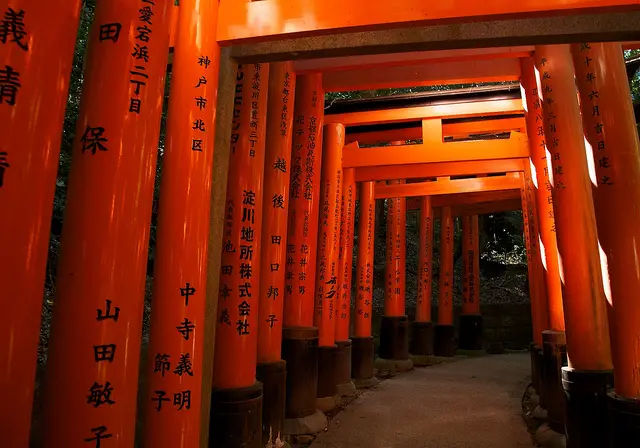
Fushimi Inari Shrine is pretty fascinating, too.
Remember when you were younger and you got on a plane for the first time? It was probably one of the craziest moments for you. It was for me at least. I distinctly remember hopping on a plane to go to Florida to see Disney World for the first time. I was about 8, and I got to sit by the window, so I could see us lift off the ground and into the sky.
I thought it was absolutely amazing and I excitedly watched out the window at the cities and buildings below. I even took a few pictures of the experience back when pictures meant something. I mean, to take a picture back then you had to actually spend money on stuff called film and then go to another place to get it developed. Do you remember that?
I was absolutely fascinated by flight. The whole idea of going up into the air and traveling at super fast speeds was mind-blowing. Now when I get on a plane to visit the States it is something I absolutely dread and want to forget about. Kind of strange how things change like that isn’t it?
Learning a language can work pretty much the same way. When you first start out, it is absolutely amazing. You want to learn as much as you possibly can about it. You might even study non-stop and find yourself buying tons of books so that you can absorb as much as you can about it.




And at first, you seem to be making pretty good progress, you can pretty much see in black and white what you are capable of and that is pretty awesome. But, then you stop being able to see your progress so much and your motivation starts to slip. Those books you bought start to gather dust and you just don’t seem to have that fire in your belly anymore.
So what happened? Well, you basically stopped being fascinated by the language. At first, when everything is new, it is pretty fascinating, like hopping on a plane for the first time. But, then after a couple of hours of study or a few plane rides, it starts to become old hat. So, how do you stop this from happening? Get fascinated again. Here are 10 of the top things that are fascinating about learning Japanese.
10 – Keigo or respectful language
It is pretty fascinating that Japanese has 3 main forms of speaking with variations in how each is used. You have sonkeigo (尊敬語), respectful language, kenjogo (謙譲語), humble language and teineigo (丁寧語), polite language. In English, these differences are a little more subtle, but in Japanese they have their own rules and structure.
9 – Japanese Culture
There are a myriad of things about Japanese culture to be fascinated about. Whether you are big fan of the modern culture of otaku and gaming or if you prefer the older, more traditional culture of Japan you can find a lot to be interested in. Find something that lights your fire and research it more. It will deepen your understanding of the culture.
The more research you do, the more you will find that Japan has always had their unique way of doing things. Even in modern times, they like to go their own way with just about everything.
8 – Japanese Food
Where else can you eat raw horse meat? Probably only in Japan. They have a whole host of unique delicacies from blowfish to the controversial whale meat. There is something for everyone to sink their teeth in. I think this is one of the biggest things you can see about different cultures. You would think that since we are all humans, we would all eat about the same stuff, but that is definitely not the case.
7 – Kanji
Okay, so Chinese has kanji, too. After all this is where kanji came from, but it is a pretty cool aspect of the language. A lot of the world’s languages have just phoentic alphabets, but only two modern languages have symbolic alphabets (Chinese and Japanese). That is pretty fascinating. Also, the actual art of writing kanji, called 書道 (shodou) in Japanese, is a skill that takes years to master.
6 – Onomonopoeia words
I wrote about these just recently in an article about sound symbolism in Japanese, but it is worth reiterating that it is pretty bad ass to have sounds that represent certain feelings and actions. This definitely brings a color to the language that makes it unique. I like being able to use these words to add style to my conversation.
5 – It is an incredibly hard language to learn
Okay, so you might not think this is all that fascinating, but for those of you that love a good challenge it is worth mentioning. If you become fluent in Japanese (and you are a native speaker of English or most other European languages) then you are in a pretty elite group of people. It is fascinating to me that so many people will go through all the pains of learning the language.
4 – Four kanji compounds (or 四字熟語, yojijukugo, in Japanese)
There are several 4 kanji compounds are idiomatic phrases formed with 4 kanji. A lot of them are from Chinese classics or Buddhist Scriptures. Each one is almost a little story in and of itself. For example, 一期一会(ichigoichie), which literally means one period one meeting, but has the idiomatic meaning of a once-in-a-lifetime experience. These are just another spice to add to the mix for your conversation.
3 – Funny Idioms
Japanese is riddled with some pretty good idioms. A warm and fuzzy one that gets used a lot is 十人十色 (ten people, ten colors) that essentially means ‘different strokes for different folks’. There is also my personal favorite, 屁をひって尻窄め (hewo hitte shiri tsubome) or ‘closing your butt checks after you fart’ or ‘No use closing the barn door after the horse got out.’
2 – Abbreviation Slang
There is a recent trend in Japanese to create words by taking commonly used phrases and just saying the first letters of the key words. A really popular one that I wrote about before is KY, which stands for kuki yomenai, or can’t read the atmosphere. This is usually used to describe someone who can’t understand the general sentiment of the public. It has recently been used to describe several politicians.
1 – Dialects
There are several Japanese dialects that each have their own little quirks. Some of them don’t even sound like Japanese anymore because they use such a wide variety of different words. One of the most popular dialects is actually kansai-ben, which is widely used in the Osaka area and made popular by a lot of the comedians that come from here.
But there are several different dialects out there to choose from, and it is regular topic of comedy shows in Japan, as you can see in this clip:
So if you have managed to master the standard dialect, how about trying your hand at a dialect for a little added challenge?
What Fascinates you about Japanese?
What fascinates you about the language? Let me know in the comments below.
Photo by Chi King


 Loading ...