
This is 5-Minute Kanji, and today, we are going to go over a giant kanji: the kanji for hour or time.
Mnemonic:
A GIant TEMPLE shines in the SUN of the golden HOUR in TOKyo. It’s a great TIME to take a picture.
Onyomi:
ジ
ji
Kunyomi:
とき
toki
The onyomi is used in a variety of compounds, usually, but not always, referring to the hour. You will see it for times of day like 7時, 7 o’clock. You will also see it in 時間, which is used to talk about hour-long lengths of time, like 1時間 – one hour (long). You will also see it in a non-N5 word – 時代, which is used to refer to a period of time. Another useful word you may see from time to time is 日時, which refers to the date and time of an event. However, this is not an N5 word.




The kunyomi, とき, has a more general meaning of time. It is more often written in kana, but can show up in kanji form from time to time. We also have the adverb 時々, which means sometimes.
Mnemonic Factory
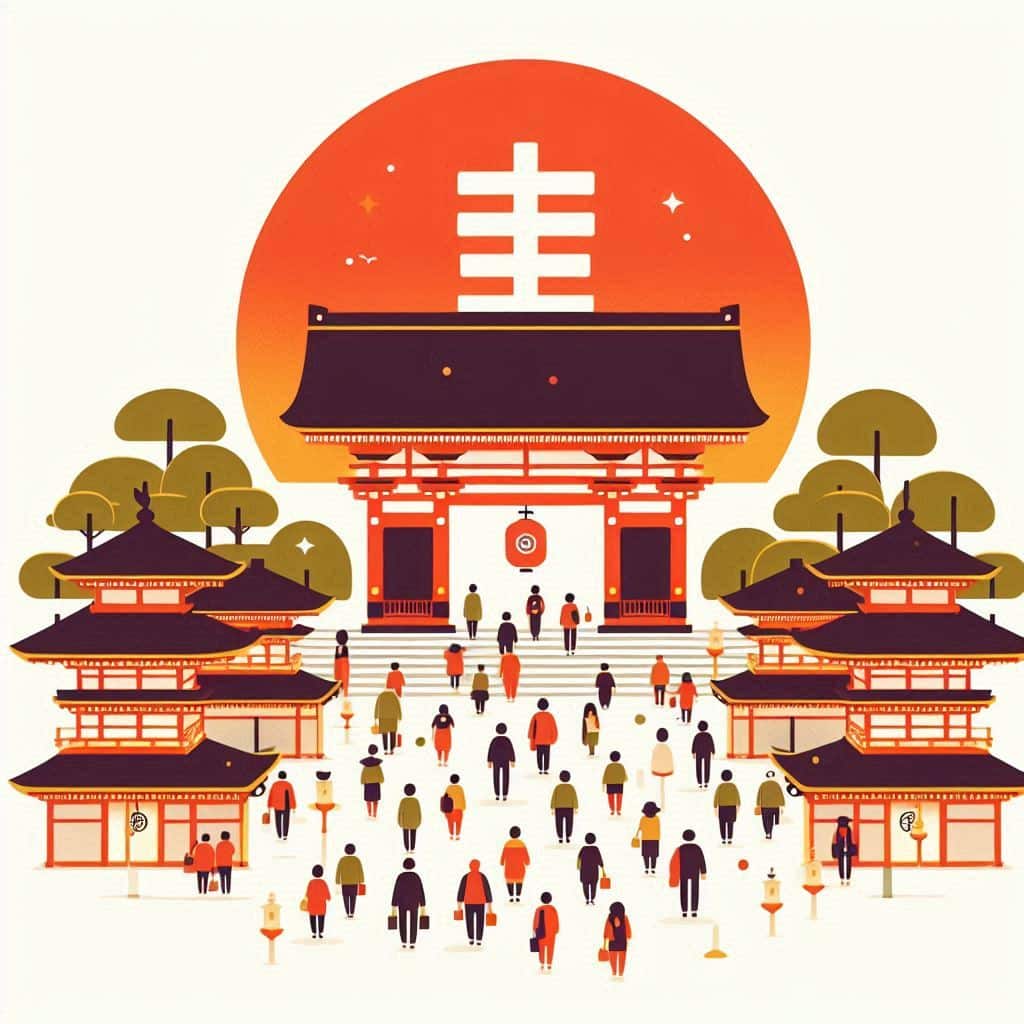
Time for temple!
We have a few visuals we can work with here. The kanji comprises two radicals: 日, sun, and 寺, temple. You can imagine a sun coming through the windows of a temple at certain times of day. Or people go to the temple the moment the sun comes up. If you are unfamiliar with the kanji for temple, it is made up of the kanji for earth or soil: 土 and a type of measurement: 寸, which started off as a stylized hand. If you squint, it can resemble a sword with an elaborate basket hilt, the part that wraps around the hand to protect it. So, you could use the visual mnemonic of a knight holding a sword upright as the sun rises to the left.
For onyomi, a wide variety of words use the じ sound, like GEE, GIant, JEans, GEnius, GEne. So you can imagine a GIant clock for time, or the GEnius? Doc Brown and his time machine.

Mastering the Ancient Art of TOE KEYing
For kunyomi, you have fewer options for とき. A common one would be to use TOKYo if you have an idea of what Tokyo looks like. Another visual reminder would be a TOKen. For a TOKen, you can play a game for a certain time. A rather strange one would be a TOe KEy. It would take some time to open a door with a TOe KEy.
Example Words
How about a few example words where this kanji is used?
Onyomi
These words are almost always written entirely in kanji (sometimes with okurigana) and preserve a Sino‐Japanese feel:
- 時間(じかん) “time; amount of time”
- 一時(いちじ) “one o’clock; temporarily”
- 時計(とけい) “clock; watch” (although the first kanji is read と, this is a special reading; the second is the kun’yomi 計, “measure”)
- 時代(じだい) “era; period; age” (Not N5)
- 時刻(じこく) “time; hour and minute” (Not N5)
These compounds typically refer to measurable or conceptual aspects of time—hours on the clock, historical periods, or the conditions surrounding an event.
Kunyomi
The kun’yomi とき is used when 時 is functioning more like a native Japanese noun, often with okurigana or in combination with hiragana:
- 時(とき) “time; moment; occasion” (stand-alone)
- 時々(ときどき) “sometimes; at times”
- 今時(いまどき) “nowadays; these days” (Not N5)
- ~の時(~のとき) “when ~; at the time of ~” (connecting phrase) (Not N5)
In these cases, とき conveys a more fluid, often qualitative sense of “time” or “occasion,” rather than a strict numerical hour.
Commonly confused with
Story Review
Can you remember the story from the beginning? Let’s give it a try and yell out the words that are missing.
A __ant ______ shines in the ___ of the golden ____ in ___yo. It’s a great ____ to take a picture.
Perfect? Let’s give it another try.
A __ant ______ shines in the ___ of the golden ____ in ___yo. It’s a great ____ to take a picture.
Word Review
Can you read these? I’ll give you the kanji and please yell out the reading for each word
時間
一時
時計
時
時々
That’s it for the kanji for time. Please let me know in the comments below if you have any questions. If you’d like to learn more kanji, hit the subscribe button and hit the bell mark to get a notification every time I send out a new video. Also, be sure to check out my other 5 Minute Kanji videos.


