![Complete JLPT N5 Study Guide [2026] post image](https://cdn-0.jlptbootcamp.com/wp-content/uploads/2025/11/pass-JLPT-N5.webp)
Introduction
What is JLPT N5?
The Japanese Language Proficiency Test (JLPT) N5 is the first level of the official Japanese language certification exam. Think of it as your starting point on the journey to Japanese fluency—it’s designed specifically for absolute beginners who want to prove they’ve built a solid foundation in the language.
N5 is the most beginner-friendly of the five JLPT levels (N5, N4, N3, N2, and N1, N5 being the easiest and N1 the most advanced). At this level, you’ll need to demonstrate that you can:
- Read and understand basic Japanese written in hiragana, katakana, and simple kanji (~100 most commonly used)
- Understand simple conversations about everyday topics when spoken slowly and clearly
- Use basic grammar patterns to form simple sentences
- Navigate common daily situations like shopping, ordering food, and introducing yourself
The test is administered twice a year (typically in July and December) in over 80 countries worldwide, making it accessible no matter where you live. It’s entirely multiple-choice and consists of three sections: Vocabulary, Grammar/Reading, and Listening.
In practical terms: If you pass N5, you’re not fluent, but you’ve proven you can handle basic Japanese in predictable, everyday situations. You’ll be able to read simple signs, understand slow conversations about familiar topics, and express basic needs and thoughts.
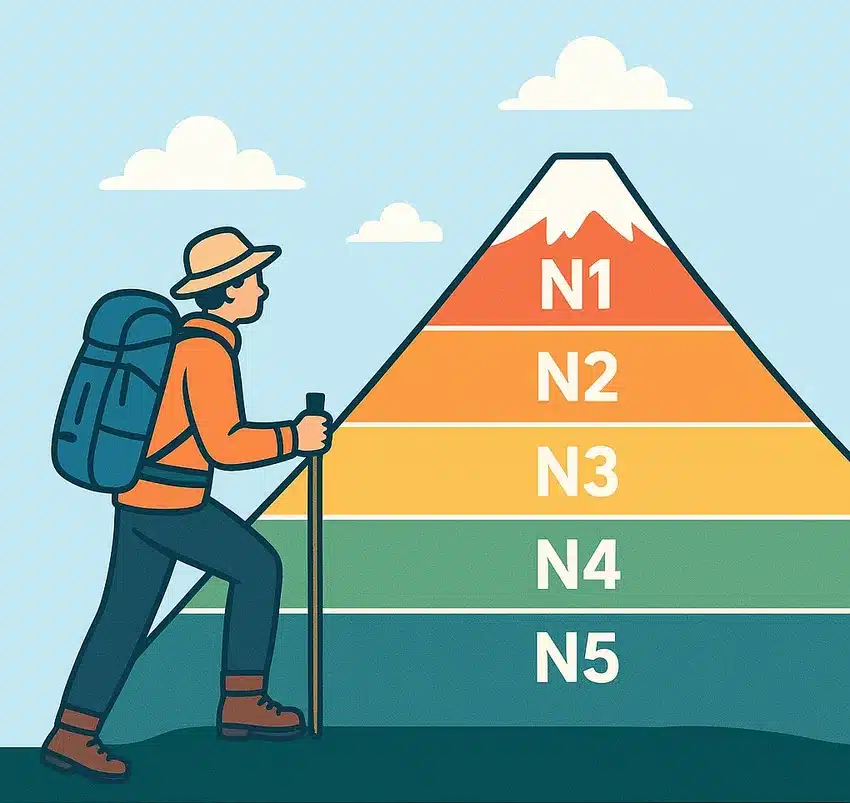
Can you make it to the top?
Why Take the N5?
You might be wondering: “Is N5 worth it, or should I just skip ahead to N4 or N3?” Here’s why thousands of learners start with N5 every year:
1. Official Proof of Your Progress
The JLPT is the most recognized Japanese language certification in the world. While N5 won’t land you a job in Tokyo, it’s official recognition that you’ve completed beginner-level Japanese. It looks great on:
- Resumes and LinkedIn profiles (shows commitment and follow-through)
- University applications (especially for study abroad programs)
- Scholarship applications
- Your personal portfolio of achievements
2. Structure and Motivation
Let’s be honest: learning Japanese is hard. Having a concrete goal with a real test date creates accountability that “someday I’ll be fluent” simply doesn’t provide. N5 gives you:
- A clear finish line to work toward
- Structured milestones (800 vocabulary words, 100 kanji, 80 grammar points)
- The satisfaction of official certification
- Motivation to stick with your studies when things get tough
Many learners report that preparing for N5 taught them how to study Japanese effectively, setting them up for success in higher levels.
3. Foundation for Higher Levels
Think of N5 as building the first floor of a house. You can’t build the second floor (N4) without it. The test ensures you’ve mastered:




- Basic sentence structure that everything else builds on
- The hiragana and katakana you’ll use every single day
- Core vocabulary that appears regularly in higher levels
- Essential grammar patterns that become components of advanced grammar
Skipping N5 might seem tempting, but many learners who rush ahead find themselves with frustrating gaps in their foundation.
4. Confidence Building
Passing your first official Japanese exam feels amazing. That certificate is tangible proof that yes, you can learn this language. For many people, N5 transforms Japanese from “that impossible language” into “a challenging but achievable goal.”
5. Personal Fulfillment
Maybe you want to:
- Connect with Japanese friends or family in their language
- Enjoy anime and manga without subtitles (someday)
- Prepare for travel to Japan
- Challenge yourself with something new
- Honor your interest in Japanese culture
N5 might not be “required” for these goals, but it represents a meaningful milestone in your personal journey.
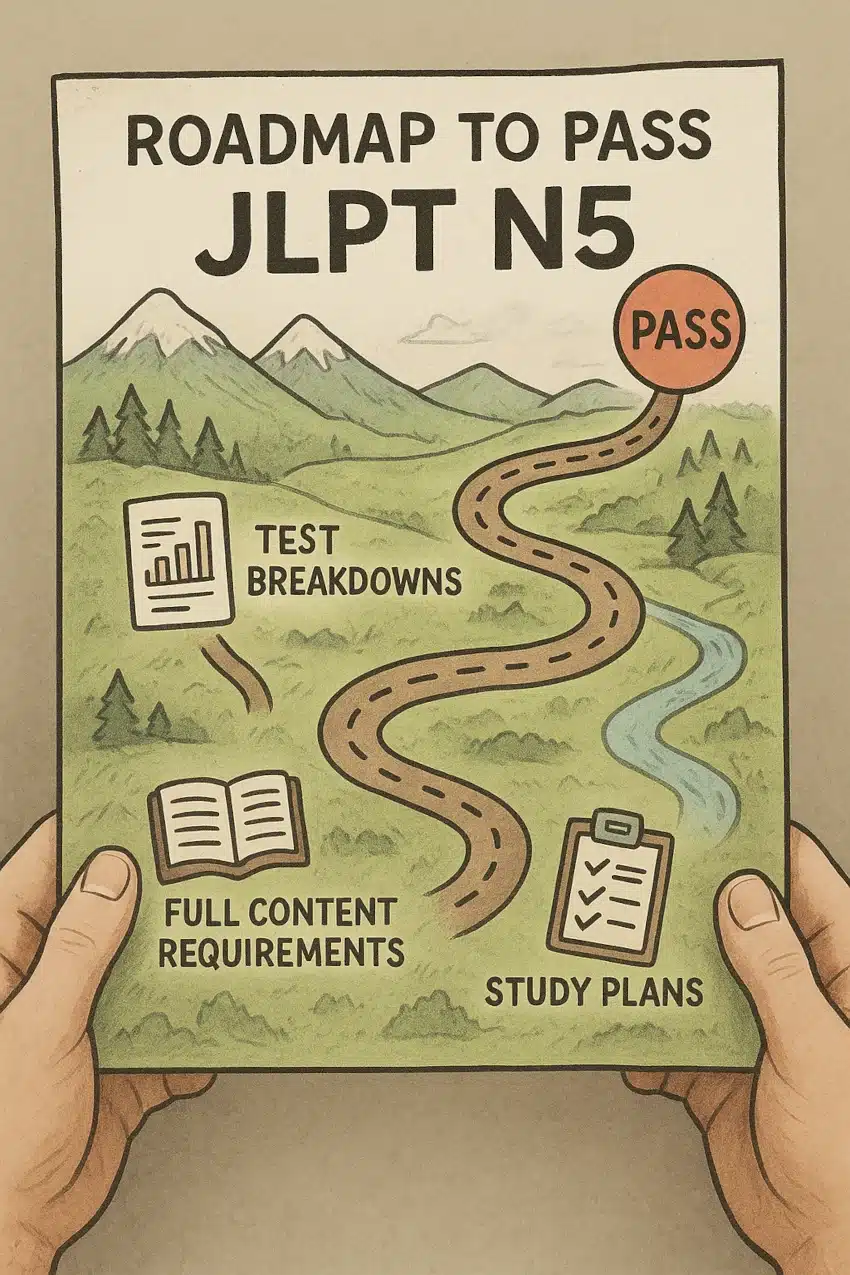
Ready for adventure?
What This Guide Covers
This is not just another JLPT overview—this is your complete roadmap from “I want to take N5” to “I passed N5.” Here’s exactly what you’ll find:
✓ Complete test breakdown: What’s actually on the test, how it’s scored, what you need to know
✓ Full content requirements: Every vocabulary word, grammar point, and kanji you need (with downloadable checklists)
✓ Flexible study plans: 3-month intensive, 6-month moderate, and 12-month relaxed schedules—pick what fits your life
✓ Resource recommendations: The best textbooks, apps, websites, and YouTube channels (with honest pros and cons)
✓ Proven study strategies: How to actually learn vocabulary, grammar, kanji, and listening (not just theory—practical techniques that work)
✓ 30-day final sprint plan: Your last-month intensive review strategy
✓ Test day survival guide: What to bring, how to manage time, what to do if you panic
✓ Free downloadable resources: Vocabulary lists, grammar sheets, study schedules, and kanji charts
What this guide is NOT:
- ❌ A replacement for actual studying (you still need to put in the hours)
- ❌ A magic shortcut (language learning takes time)
- ❌ A complete Japanese course (you’ll need textbooks or apps alongside this)
Think of this guide as your GPS. It shows you the route, warns you about obstacles, and keeps you on track—but you’re still the one who has to make the journey.
Your Roadmap to Passing
Here’s the truth: thousands of people pass JLPT N5 every year, and you can be one of them. You don’t need to be a genius, have a perfect memory, or spend eight hours a day studying. You just need a solid plan and consistent effort.
Here’s What Success Looks Like:
Phase 1: Learn the Basics (Months 1-3)
- Master hiragana and katakana (first 2-3 weeks)
- Build your vocabulary to 800 words
- Learn essential grammar patterns
- Start recognizing 100 kanji
Phase 2: Practice and Apply (Months 3-5)
- Read simple texts and sentences
- Practice listening to slow, clear Japanese
- Do practice problems from textbooks
- Start connecting grammar points together
Phase 3: Test Preparation (Month 6)
- Take full practice tests
- Identify and fix weak areas
- Build test-taking stamina (the full test is 105 minutes)
- Review, review, review
Phase 4: Final Sprint (Last 30 Days)
- Intensive practice tests
- Focus on listening (usually the hardest section)
- Fine-tune time management
- Build confidence
The Realistic Time Commitment:
Most learners need 300-500 hours of study to pass N5 comfortably. That breaks down to:
- 6 months: 10-15 hours per week (sustainable for most people)
- 3 months: 20-25 hours per week (intensive but doable)
- 12 months: 5-8 hours per week (perfect for busy schedules)
Notice something? All three paths require about the same total hours. The question isn’t whether you have time—it’s how you want to distribute it.
What You Need to Succeed:
✅ Consistency over intensity: Studying 1 hour daily beats cramming 7 hours on Sunday
✅ The right resources: You don’t need everything—just a good textbook, practice tests, and supplementary apps
✅ Realistic expectations: Some days will feel frustrating. That’s normal. Learning curves aren’t linear.
✅ A support system: Join online communities (Reddit’s r/LearnJapanese, Discord servers, study groups)
✅ This guide: Your strategic roadmap through the chaos of “where do I even start?”
Your First Steps Start Now:
- Decide your timeline: 3, 6, or 12 months? Pick based on your schedule, not what sounds impressive.
- Register for the test: Having a date on the calendar makes it real. Next test dates are in July and December 2025.
- Gather your resources: You’ll need at least one textbook, a vocabulary app, and practice tests (we’ll recommend specific ones later).
- Start today: Not tomorrow, not Monday. Read section 1 of this guide and begin learning hiragana tonight.
One More Thing:
You might not feel ready. You might feel overwhelmed. You might think “maybe I should wait until I’m more prepared.”
Here’s what we know after watching thousands of students: the people who pass are simply the ones who start. Not the smartest. Not the most talented. Just the ones who decide “I’m doing this” and put in consistent work.
This guide will show you exactly how.
Ready? Let’s begin.
Next: Section 1: Understanding the JLPT N5 →
Download your free N5 Study Starter Pack: Includes vocabulary checklist, grammar reference, and printable study schedule. Get it here


 Loading ...