Section 2: What You Need to Know for N5
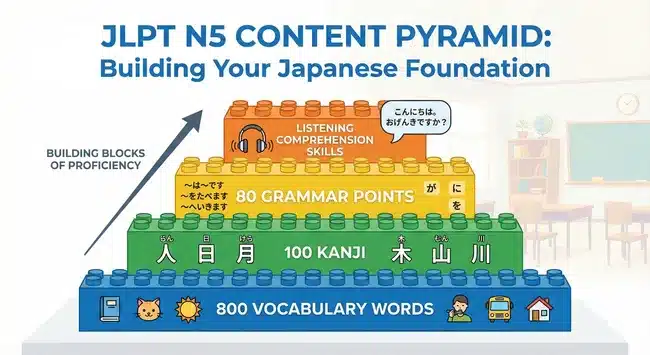
Now that you understand the test format, let’s break down exactly what content you need to master. This section covers the complete scope of vocabulary, grammar, kanji, and listening skills required for N5.
2.1 Vocabulary Requirements
Vocabulary is the foundation of your N5 study. You’ll need to recognize and understand approximately 800 words that cover everyday situations and basic communication.
Total Vocabulary Count: ~800 Words
The JLPT N5 requires knowledge of approximately 800-1,000 essential Japanese words. While there’s no official vocabulary list published by the JLPT organizers, this number is based on analysis of past tests and official practice materials.
What “knowing” a word means for N5:
- Recognize the word when you see it in hiragana, katakana, or basic kanji
- Understand its meaning in context
- Know common collocations (words that frequently appear together)
- Note: You don’t need to produce these words from memory—only recognize and understand them
Word Categories You’ll Encounter
N5 vocabulary covers fundamental topics for daily life. Here’s a breakdown by category:
Common Verbs (~100-120 verbs)
Verbs are the backbone of Japanese sentences. Here are 50 essential examples:
Daily Actions:
食べる (taberu) – to eat
飲む (nomu) – to drink
見る (miru) – to see, to watch
聞く (kiku) – to hear, to listen
話す (hanasu) – to speak
読む (yomu) – to read
書く (kaku) – to write
寝る (neru) – to sleep
起きる (okiru) – to wake up
歩く (aruku) – to walk
Movement & Location:
行く (iku) – to go
来る (kuru) – to come
帰る (kaeru) – to return home
入る (hairu) – to enter
出る (deru) – to exit
乗る (noru) – to ride
降りる (oriru) – to get off
立つ (tatsu) – to stand
座る (suwaru) – to sit
ある (aru) – to exist (inanimate)
いる (iru) – to exist (animate)
Daily Activities:
買う (kau) – to buy
売る (uru) – to sell
作る (tsukuru) – to make
洗う (arau) – to wash
開ける (akeru) – to open
閉める (shimeru) – to close
始める (hajimeru) – to begin
終わる (owaru) – to end
待つ (matsu) – to wait
休む (yasumu) – to rest
Communication & Giving:
言う (iu) – to say
教える (oshieru) – to teach
習う (narau) – to learn
会う (au) – to meet
あげる (ageru) – to give
もらう (morau) – to receive
貸す (kasu) – to lend
借りる (kariru) – to borrow
分かる (wakaru) – to understand
知る (shiru) – to know
States & Actions:
する (suru) – to do
なる (naru) – to become
いる (iru) – to need
思う (omou) – to think
持つ (motsu) – to have, to hold
使う (tsukau) – to use
働く (hataraku) – to work
遊ぶ (asobu) – to play
勉強する (benkyou suru) – to study
練習する (renshuu suru) – to practice
Essential Adjectives (i-adjectives & na-adjectives)
Adjectives in Japanese come in two types, and you need to know both:
I-adjectives (end in い):
大きい (ookii) – big
小さい (chiisai) – small
高い (takai) – tall, expensive
安い (yasui) – cheap
新しい (atarashii) – new
古い (furui) – old
良い/いい (yoi/ii) – good
悪い (warui) – bad
多い (ooi) – many
少ない (sukunai) – few
暑い (atsui) – hot (weather)
寒い (samui) – cold (weather)
熱い (atsui) – hot (to touch)
冷たい (tsumetai) – cold (to touch)
難しい (muzukashii) – difficult
易しい (yasashii) – easy
面白い (omoshiroi) – interesting
つまらない (tsumaranai) – boring
忙しい (isogashii) – busy
楽しい (tanoshii) – fun
Na-adjectives (descriptive nouns):
きれい (kirei) – pretty, clean
静か (shizuka) – quiet
にぎやか (nigiyaka) – lively
便利 (benri) – convenient
不便 (fuben) – inconvenient
好き (suki) – like
嫌い (kirai) – dislike
上手 (jouzu) – skilled
下手 (heta) – unskilled
元気 (genki) – healthy, energetic
親切 (shinsetsu) – kind
簡単 (kantan) – simple
大切 (taisetsu) – important
有名 (yuumei) – famous
暇 (hima) – free time
Daily Life Nouns
N5 nouns cover everyday objects, places, and concepts:
Family & People: 家族 (kazoku) – family, 母 (haha) – mother, 父 (chichi) – father, 兄弟 (kyoudai) – siblings, 友達 (tomodachi) – friend, 先生 (sensei) – teacher, 学生 (gakusei) – student
Places: 家 (ie/uchi) – home, 学校 (gakkou) – school, 会社 (kaisha) – company, 駅 (eki) – station, 店 (mise) – shop, レストラン (resutoran) – restaurant, 病院 (byouin) – hospital, 銀行 (ginkou) – bank
Food & Drink: 水 (mizu) – water, お茶 (ocha) – tea, コーヒー (koohii) – coffee, ご飯 (gohan) – rice/meal, パン (pan) – bread, 肉 (niku) – meat, 魚 (sakana) – fish, 野菜 (yasai) – vegetables
Objects: 本 (hon) – book, ペン (pen) – pen, 紙 (kami) – paper, 机 (tsukue) – desk, 椅子 (isu) – chair, かばん (kaban) – bag, 時計 (tokei) – clock/watch, 電話 (denwa) – telephone
Transportation: 車 (kuruma) – car, 電車 (densha) – train, バス (basu) – bus, 自転車 (jitensha) – bicycle, 飛行機 (hikouki) – airplane
Time Expressions
Essential for scheduling and talking about when things happen:
General Time:
今 (ima) – now
今日 (kyou) – today
昨日 (kinou) – yesterday
明日 (ashita) – tomorrow
今週 (konshuu) – this week
先週 (senshuu) – last week
来週 (raishuu) – next week
今月 (kongetsu) – this month
先月 (sengetsu) – last month
来月 (raigetsu) – next month
今年 (kotoshi) – this year
去年 (kyonen) – last year
来年 (rainen) – next year




Time of Day:
朝 (asa) – morning
昼 (hiru) – noon, daytime
夜 (yoru) – night
午前 (gozen) – AM
午後 (gogo) – PM
毎日 (mainichi) – every day
毎週 (maishuu) – every week
毎月 (maitsuki) – every month
毎年 (maitoshi) – every year
Days of the Week:
月曜日 (getsuyoubi) – Monday
火曜日 (kayoubi) – Tuesday
水曜日 (suiyoubi) – Wednesday
木曜日 (mokuyoubi) – Thursday
金曜日 (kinyoubi) – Friday
土曜日 (doyoubi) – Saturday
日曜日 (nichiyoubi) – Sunday
Counter Words Basics
Japanese uses specific counters for different types of objects. N5 covers the most common ones:
General Counters:
~つ (tsu) – general counter for objects (ひとつ、ふたつ、みっつ…)
~人 (nin) – counter for people (一人、二人、三人…)
~枚 (mai) – counter for flat objects (paper, plates, shirts)
~本 (hon/bon/pon) – counter for long objects (pens, bottles, trees)
~冊 (satsu) – counter for books
~匹 (hiki/biki/piki) – counter for small animals
~台 (dai) – counter for machines/vehicles
~回 (kai) – counter for times/occurrences
Time Counters:
~時 (ji) – o’clock
~分 (fun/pun) – minutes
~日 (nichi) – days
~週間 (shuukan) – weeks
~ヶ月 (kagetsu) – months
~年 (nen) – years
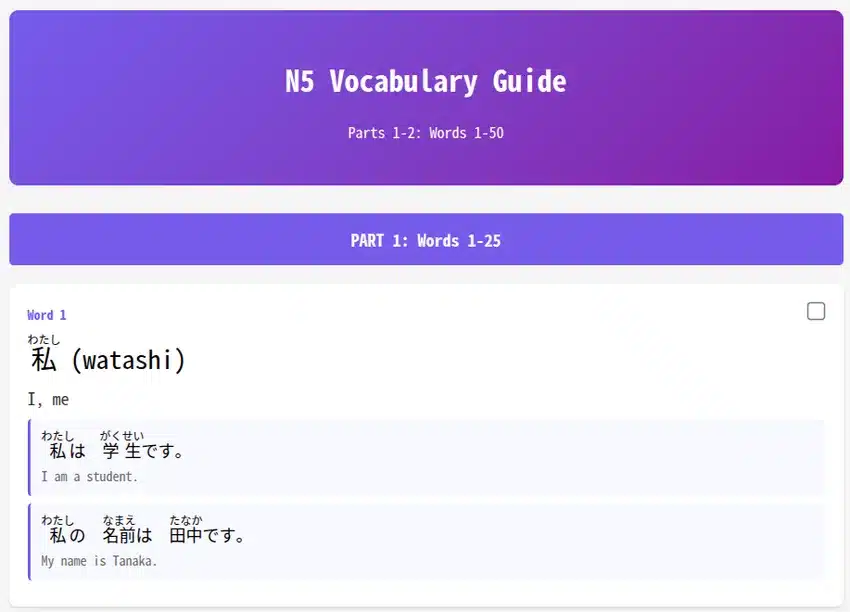
Download: N5 Vocabulary Checklist PDF (800 words)
[Download Link] Get our complete N5 vocabulary checklist with:
- All 800 words organized by category
- Kanji, hiragana, and romaji for each word
- English meanings
- Example sentences for context
- Checkboxes to track your progress
2.2 Grammar Requirements
Grammar is what allows you to put all those vocabulary words together into meaningful sentences. N5 covers approximately 80 essential grammar points.
Number of Grammar Points: ~80
While there’s no official grammar list from the JLPT, analysis of past tests shows that approximately 80 grammar patterns appear consistently at the N5 level. These form the foundation of basic Japanese sentence structure.
Important note: Unlike vocabulary where you just need to recognize words, with grammar you need to understand how patterns work and be able to identify correct usage in sentences.
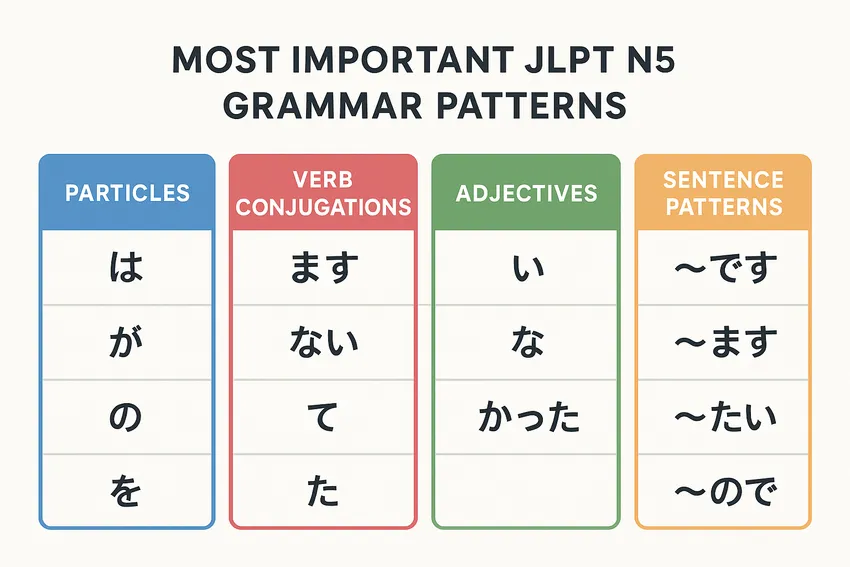
Essential Grammar Categories
Basic Sentence Structure
は (wa) particle – Topic marker
Marks the topic of a sentence
Example: 私は学生です。(Watashi wa gakusei desu.) – I am a student.
です/だ (desu/da) – Copula
Means “is/am/are” and comes at the end of sentences
Example: これはペンです。(Kore wa pen desu.) – This is a pen.
か (ka) – Question particle
Turns statements into questions
Example: 学生ですか。(Gakusei desu ka?) – Are you a student?
Verb Conjugations
Japanese verbs conjugate differently based on tense and politeness:
Present/Future Tense (Polite):
食べます (tabemasu) – eat/will eat
行きます (ikimasu) – go/will go
Past Tense (Polite):
食べました (tabemashita) – ate
行きました (ikimashita) – went
Negative Present:
食べません (tabemasen) – don’t eat/won’t eat
行きません (ikimasen) – don’t go/won’t go
Negative Past:
食べませんでした (tabemasendeshita) – didn’t eat
行きませんでした (ikimasendeshita) – didn’t go
Adjective Conjugations
I-adjectives:
- Present: 大きい (ookii) – is big
- Past: 大きかった (ookikatta) – was big
- Negative: 大きくない (ookikunai) – is not big
- Negative Past: 大きくなかった (ookikunakatta) – was not big
Na-adjectives:
- Present: 静かです (shizuka desu) – is quiet
- Past: 静かでした (shizuka deshita) – was quiet
- Negative: 静かじゃないです (shizuka ja nai desu) – is not quiet
- Negative Past: 静かじゃなかったです (shizuka ja nakatta desu) – was not quiet
Particles (は、が、を、に、で、へ、と、も、か)
Particles are small words that show the relationship between parts of a sentence:
は (wa) – Topic marker: “As for X…”
が (ga) – Subject marker: Indicates the grammatical subject
を (wo/o) – Direct object marker: Shows what receives the action
に (ni) – Location/time/indirect object marker
で (de) – Location of action/means/method marker
へ (e) – Direction marker: “toward”
と (to) – “and” (connects nouns), “with” (accompaniment)
も (mo) – “also,” “too”
か (ka) – Question marker, “or”
Examples:
私は日本語を勉強します。(I study Japanese.)
図書館で本を読みます。(I read books at the library.)
駅へ行きます。(I’m going toward the station.)
友達と映画を見ました。(I watched a movie with a friend.)
Question Words (何、誰、どこ、いつ、なぜ)
何 (nani/nan) – what
誰 (dare) – who
どこ (doko) – where
いつ (itsu) – when
なぜ (naze) / どうして (doushite) – why
どう (dou) – how
いくら (ikura) – how much (price)
いくつ (ikutsu) – how many, how old
どれ (dore) – which one
どの (dono) – which (+ noun)
Counting and Numbers
Basic Numbers:
一 (ichi) – 1, 二 (ni) – 2, 三 (san) – 3, 四 (yon/shi) – 4, 五 (go) – 5
六 (roku) – 6, 七 (nana/shichi) – 7, 八 (hachi) – 8, 九 (kyuu/ku) – 9, 十 (juu) – 10
Grammar patterns for counting:
~個 (ko) – counter for small objects
~人 (nin) – counter for people
~つ (tsu) – native Japanese counter
Te-form Basics
The te-form (~て) is one of the most important conjugations in Japanese:
Uses of te-form:
- Requests: 食べてください (tabete kudasai) – Please eat
- Permission: 食べてもいいです (tabete mo ii desu) – You may eat
- Prohibition: 食べてはいけません (tabete wa ikemasen) – You must not eat
- Ongoing action: 食べています (tabete imasu) – is eating
- Connecting actions: 起きて、朝ごはんを食べました (I woke up and ate breakfast)
Desire Expressions (たい)
~たい (tai) – want to (do something)
Verb stem + たいです
Example: 日本へ行きたいです。(Nihon e ikitai desu.) – I want to go to Japan.
~が欲しい (ga hoshii) – want (something)
Example: 新しい車が欲しいです。(Atarashii kuruma ga hoshii desu.) – I want a new car.
Comparison (より、の方が)
AよりB (A yori B) – B more than A
Example: コーヒーよりお茶が好きです。(I like tea more than coffee.)
AとBとどちらの方が (A to B to dochira no hou ga) – Which is more, A or B?
Example: りんごとバナナとどちらの方が好きですか。(Which do you like better, apples or bananas?)
Aの方がBより (A no hou ga B yori) – A is more than B
Example: 東京の方が大阪より大きいです。(Tokyo is bigger than Osaka.)
Other Essential Grammar Patterns:
- ~ましょう (mashou) – Let’s…, Shall we…?
- ~ませんか (masen ka) – Won’t you…? (invitation)
- ~ことができます (koto ga dekimasu) – can do, be able to
- ~まえに (mae ni) – before
- ~あとで (ato de) – after
- ~から (kara) – because, from
- ~が (ga) – but
- ~ね / ~よ (ne/yo) – sentence-ending particles for emphasis/confirmation
Download: N5 Grammar Points Reference Sheet
[Download Link] Get our comprehensive N5 grammar guide with:
- All 80 grammar points explained in detail
- Formation rules and conjugation patterns
- Multiple example sentences for each pattern
- Common mistakes to avoid
- Practice exercises with answer keys
2.3 Kanji Requirements
Kanji are Chinese characters used in written Japanese. For N5, you need to recognize approximately 100 basic kanji.
Total Kanji: ~100 Characters
The JLPT N5 requires knowledge of approximately 100-103 kanji. This is a manageable number and covers the most fundamental characters you’ll encounter in beginner-level Japanese.
Good news: You only need to recognize these kanji, not write them from memory. The test is multiple-choice, so you’ll select correct readings and meanings, not produce them yourself.
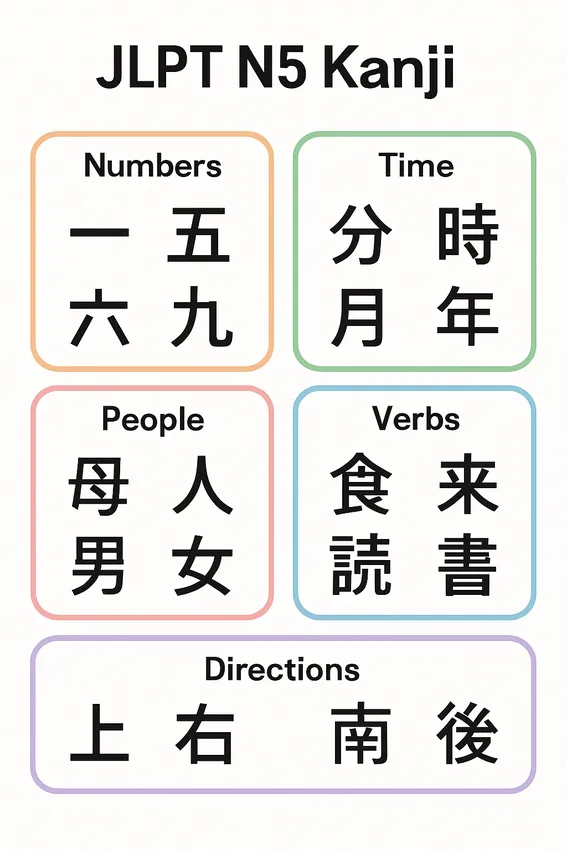
Kanji by Category
Numbers (一、二、三…)
The most basic and essential kanji:
一 (ichi) – one
二 (ni) – two
三 (san) – three
四 (yon/shi) – four
五 (go) – five
六 (roku) – six
七 (nana/shichi) – seven
八 (hachi) – eight
九 (kyuu/ku) – nine
十 (juu) – ten
百 (hyaku) – hundred
千 (sen) – thousand
万 (man) – ten thousand
円 (en) – yen, circle
Days/Time (日、月、年…)
Essential for schedules, dates, and time expressions:
日 (hi/nichi/ka) – day, sun
月 (tsuki/getsu/gatsu) – month, moon
火 (hi/ka) – fire, Tuesday
水 (mizu/sui) – water, Wednesday
木 (ki/moku) – tree, Thursday
金 (kane/kin) – gold, money, Friday
土 (tsuchi/do) – earth, Saturday
年 (toshi/nen) – year
週 (shuu) – week
時 (toki/ji) – time, hour
分 (fun/pun/bun) – minute, to divide
半 (han) – half
今 (ima/kon) – now
毎 (mai) – every
何 (nani/nan) – what
People (人、男、女…)
Characters related to people and relationships:
人 (hito/jin/nin) – person
男 (otoko/dan) – male
女 (onna/jo) – female
子 (ko/shi) – child
母 (haha/bo) – mother
父 (chichi/fu) – father
友 (tomo/yuu) – friend
先 (saki/sen) – previous, ahead
生 (sei/shou) – life, birth
学 (gaku) – learning, study
校 (kou) – school
名 (na/mei) – name
Common Verbs (見る、行く、食べる…)
Action words you’ll use constantly:
見 (mi) – to see
行 (i/kou/gyou) – to go
来 (ku/rai) – to come
食 (ta/shoku) – to eat
飲 (no/in) – to drink
買 (ka/bai) – to buy
書 (ka/sho) – to write
読 (yo/doku) – to read
話 (hana/wa) – to speak
聞 (ki/bun) – to listen, ask
出 (de/shutsu) – to exit, come out
入 (hai/nyuu) – to enter
立 (ta/ritsu) – to stand
休 (yasu/kyuu) – to rest
会 (a/kai) – to meet
Directions (上、下、中…)
Position and direction words:
上 (ue/jou) – up, above
下 (shita/ka/ge) – down, below
中 (naka/chuu) – middle, inside
外 (soto/gai) – outside
左 (hidari/sa) – left
右 (migi/u/yuu) – right
前 (mae/zen) – front, before
後 (ato/ushi/go/kou) – back, after, behind
東 (higashi/tou) – east
西 (nishi/sei) – west
南 (minami/nan) – south
北 (kita/hoku) – north
口 (kuchi/kou) – mouth, entrance
手 (te/shu) – hand
Other Essential Categories:
Body parts: 目 (me) – eye, 耳 (mimi) – ear, 足 (ashi) – leg/foot
Places: 国 (kuni) – country, 町 (machi) – town, 店 (mise) – shop, 駅 (eki) – station
Nature: 山 (yama) – mountain, 川 (kawa) – river, 天 (ten) – heaven/sky, 気 (ki) – spirit/energy
Colors: 白 (shiro) – white, 黒 (kuro) – black, 青 (ao) – blue, 赤 (aka) – red
Sizes/amounts: 大 (oo/dai) – big, 小 (ko/shou) – small, 高 (taka/kou) – tall/high, 安 (yasu/an) – cheap/safe, 多 (oo/ta) – many, 少 (suku/shou) – few
Common words: 本 (hon) – book, 車 (kuruma) – car, 電 (den) – electricity, 語 (go) – language
Reading vs. Writing Requirements
Critical distinction for N5: You only need to recognize and read kanji, not write them from memory.
What this means for your study:
- Recognition: You must be able to see a kanji and know its reading(s) and meaning
- Context: Understand what the kanji means when used in words and sentences
- Multiple readings: Many kanji have different readings depending on context (e.g., 生: sei in 先生, nama in 生ビール)
- NO writing required: You don’t need to reproduce kanji from memory with correct stroke order
However, writing practice can still help:
- Writing helps with memorization and recognition
- Understanding stroke order helps you recognize kanji faster
- Many learners find that writing a kanji 5-10 times helps it stick in memory
- But you can pass N5 without ever writing a single kanji if recognition is your focus
On the test, you’ll encounter kanji in questions like:
- “What is the reading of this kanji?” (multiple choice with hiragana options)
- “Which kanji represents this word?” (shown in hiragana, choose the kanji)
- “What does this kanji/word mean?” (choose from English or Japanese definitions)
- Reading passages where kanji appear with furigana (small hiragana above) or without
Download: N5 Kanji List with Readings
[Download Link] Get our complete N5 kanji reference guide with:
- All 100+ kanji
- On’yomi (Chinese reading) and kun’yomi (Japanese reading) for each character
- Common vocabulary words using each kanji
- Practice worksheets with answer keys
- Flashcard-ready format for printing or digital use
2.4 Listening Comprehension
The listening section is often considered the most challenging part of N5 for self-study learners. Unlike vocabulary and grammar that you can study at your own pace, listening requires real-time processing of spoken Japanese.
Types of Listening Questions
The N5 listening section contains approximately 20 questions divided into three question types:
Task-based Understanding (課題理解 / Kadai Rikai)
What it tests: Your ability to understand what action needs to be taken based on a conversation
Format:
- You hear a short conversation or monologue (usually 30-60 seconds)
- You see a question and 3-4 answer choices (pictures or text)
- You must identify what the speaker will do next or what they should do
Example scenario:
You hear: Two coworkers talking about lunch plans. One says they want something quick because they have a 1 PM meeting.
Question: “Where will they go?”
Options: (Pictures of) A) Fancy restaurant B) Convenience store C) Café D) Fast food restaurant
Answer: B or D (something quick)
Skills needed:
- Identify the main topic quickly
- Catch key information (time, place, preferences)
- Understand cause-and-effect (because X, therefore Y)
- Ignore filler information and focus on what matters
Point Comprehension (ポイント理解 / Pointo Rikai)
What it tests: Your ability to catch specific details from a conversation
Format:
- You hear a conversation or announcement
- You’re asked about a specific detail mentioned in the audio
- You select from 3-4 answer choices
Example scenario:
You hear: A train station announcement about a delayed train
Question: “What time will the train arrive?”
Options: A) 2:15 B) 2:30 C) 2:45 D) 3:00
Answer: Based on what was stated in the announcement
Skills needed:
- Catch specific numbers (times, prices, quantities)
- Identify people mentioned (who did what)
- Understand locations (where something is/will happen)
- Remember details while listening to the full conversation
Verbal Expressions (発話表現 / Hatsuwa Hyougen)
What it tests: Your knowledge of appropriate responses in social situations
Format:
- You hear a short statement or question
- You must choose the most appropriate response from 3 options
- Tests social/cultural appropriateness, not just grammar
Example scenario:
You hear: “昨日のパーティーはどうでしたか。” (How was yesterday’s party?)
Options (audio):
A) “はい、行きました。” (Yes, I went.)
B) “とても楽しかったです。” (It was very fun.)
C) “明日です。” (It’s tomorrow.)
Answer: B (appropriate response to “how was it?”)
Skills needed:
- Understand question types (when, where, how, why)
- Know polite vs. casual responses
- Recognize appropriate social expressions
- Distinguish between similar-sounding responses
Common Listening Topics at N5 Level
The listening section uses realistic, everyday situations that beginners might encounter:
Daily Life:
- Making plans with friends (meeting times, locations)
- Shopping conversations (prices, quantities, colors, sizes)
- Ordering food at restaurants
- Asking for and giving directions
- Daily schedule and routines
School/Work:
- Classroom instructions
- Homework and assignment details
- Test schedules
- Simple work tasks and instructions
Services & Facilities:
- Train/bus station announcements
- Store opening hours and locations
- Weather forecasts (simple)
- Phone conversations (basic information exchange)
- Hotel or facility information
Personal Topics:
- Family and friends
- Hobbies and interests
- Weekend plans and activities
- Likes and dislikes
- Past experiences (what someone did yesterday, last week)
Speed and Difficulty Expectations
Speaking Speed:
- N5 listening audio is deliberately slowed down compared to natural Japanese speech
- Speakers enunciate clearly and pause between sentences
- Approximate speed: 2-3 mora (Japanese sound units) per second vs. 4-5 in natural speech
- Most conversations are 30-90 seconds long
Audio Characteristics:
- Clear pronunciation: No mumbling or strong accents
- Standard Japanese: Tokyo dialect, formal/polite speech patterns
- Background noise: Minimal to none (you’ll hear the conversation clearly)
- Number of speakers: Usually 2-3 people per conversation
Difficulty Level:
- Vocabulary is limited to N5-level words
- Grammar structures are basic and clear
- Sentences are relatively short (10-15 words maximum)
- Context is usually clear from the beginning
- No complex or abstract topics
The Challenge:
- Audio plays only once: You cannot rewind or replay
- Real-time processing: Must understand while listening, not after
- Multiple questions: Sometimes need to remember details from earlier in the conversation
- Distractor information: Conversations may include irrelevant details you need to ignore
- Homophones: Words that sound similar but have different meanings (は vs. わ, を vs. お)
Listening Practice Tips
Since listening is often the hardest section for self-study learners, here are quick strategies:
Before the test:
- Practice with JLPT-specific listening materials (official practice tests, textbook CDs)
- Listen to beginner-level Japanese podcasts or YouTube channels daily
- Watch Japanese content with Japanese subtitles (not English) to connect sound with meaning
- Shadow native speakers to internalize natural rhythm and intonation
- Use apps like JapanesePod101 or NHK Easy Japanese for leveled listening practice
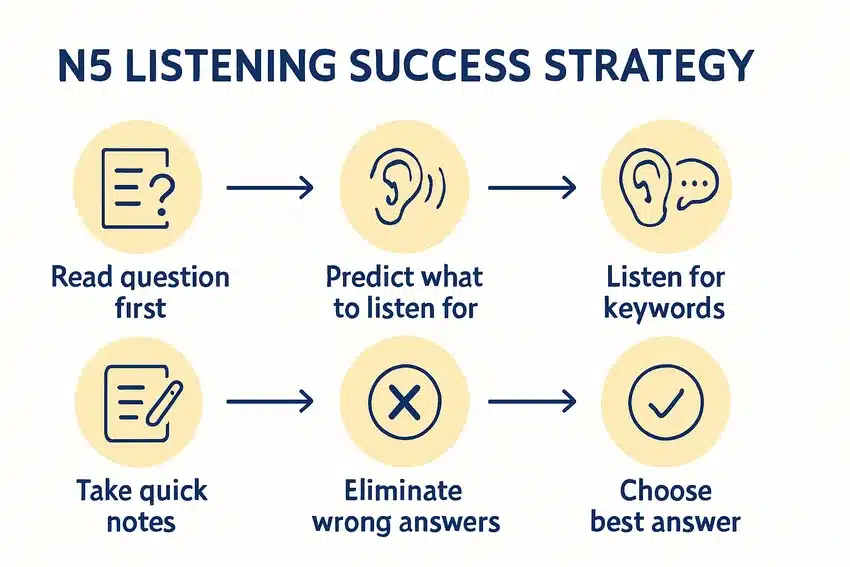
During the test:
- Read the question and answer choices BEFORE the audio starts (you have time)
- Predict what information you need to listen for
- Take brief notes on numbers, times, or key words
- Don’t panic if you miss something—listen for the answer to the specific question
- Eliminate obviously wrong answers quickly
- Trust your first instinct if you’re unsure
Section 2 Summary:
You now know exactly what content N5 covers:
- ✅ ~800 vocabulary words across essential categories
- ✅ ~80 grammar patterns for basic communication
- ✅ ~100 kanji for reading (recognition only)
- ✅ 3 types of listening questions testing real-world comprehension
In the next section, we’ll show you exactly how to study all of this content efficiently with proven learning strategies and realistic timelines.


 Loading ...