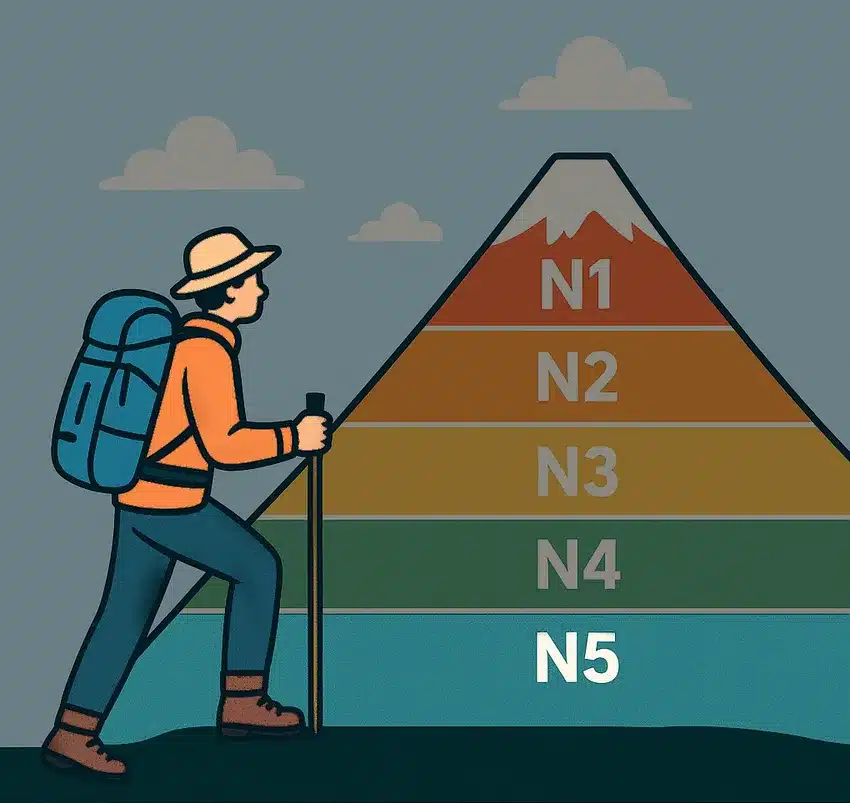
1.1 Test Format & Structure
The JLPT N5 is entirely multiple-choice and consists of three main sections that test your language knowledge, reading comprehension, and listening skills. Here’s exactly what you’ll face on test day:
Test Sections Breakdown
Section 1: Language Knowledge (Vocabulary)
Time: 25 minutes
Number of questions: Approximately 25 questions
What it tests: Basic vocabulary recognition, kanji readings, word meanings, and context-appropriate word choice
This section evaluates whether you can recognize approximately 800 basic Japanese words and understand how they’re used in everyday situations. You’ll see questions like:
- Choosing the correct kanji reading for a word. You’ll see the word in kanji, and you must select the hiragana reading of it.
- Selecting the right word to complete a sentence
- Matching words with similar or related meanings
Section 2: Language Knowledge (Grammar & Reading)
Time: 50 minutes
Number of questions: Approximately 32 questions
What it tests: Grammar patterns, sentence structure, and reading comprehension
This combined section is split into two parts:
- Grammar questions: Selecting correct particles, verb forms, and grammatical patterns to complete sentences
- Reading comprehension: Understanding short passages, signs, notices, simple emails, and basic dialogues
Reading passages at N5 level are typically 50-150 words and cover everyday topics like shopping, schedules, simple instructions, and casual conversations.
Section 3: Listening
Time: 30 minutes
Number of questions: Approximately 20 questions
What it tests: Understanding spoken Japanese in everyday situations
The listening section includes three question types:
- Task-based comprehension: Listen to a short conversation and identify what action should be taken
- Key point understanding: Identify specific details or information from what you hear
- Quick response: Choose the most appropriate reply to a spoken statement or question
Important note: Audio is played only once, so focused listening is essential. The speech is slow and clear, designed for beginners.
Total Test Time & Question Count
The entire JLPT N5 exam takes 105 minutes (1 hour and 45 minutes) of active testing time. You’ll answer approximately 77-80 total questions across all three sections. There are short breaks between sections for distributing test booklets.
How the Test is Scored (Scaled Scoring System)
Here’s where it gets interesting: the JLPT doesn’t use a simple “number of correct answers” scoring system. Instead, it uses scaled scoring based on Item Response Theory (IRT).
What this means: Your score is adjusted based on the difficulty of the specific questions you answered. This ensures fairness across different test versions since not all tests are exactly the same difficulty level.
Score ranges:
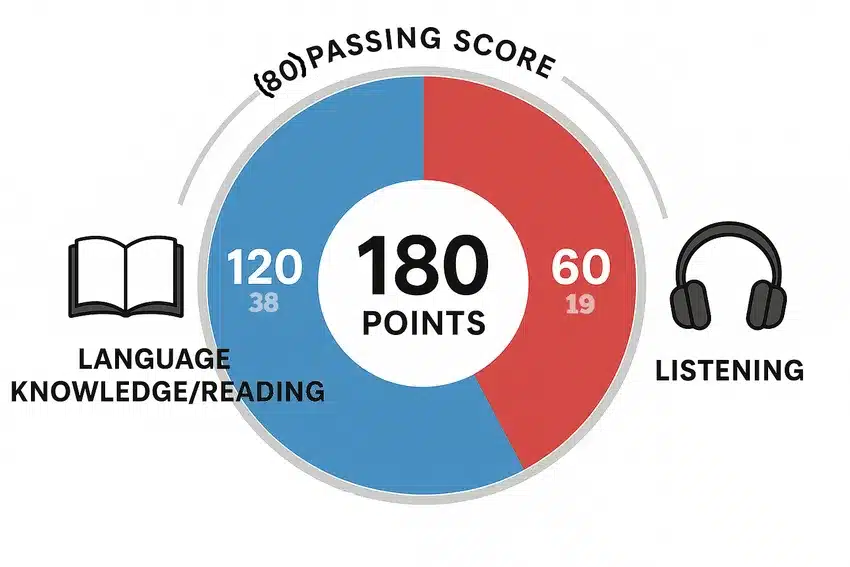
- Language Knowledge (Vocabulary/Grammar) + Reading: 0-120 points
- Listening: 0-60 points
- Total possible score: 0-180 points
Why you can’t just count correct answers: Because of the scaled scoring system, you cannot directly calculate your score by counting how many questions you got right. Two people who answer the same number of questions correctly might receive slightly different scores depending on which specific questions they answered correctly and their difficulty level.
Passing Score Requirements
To pass JLPT N5, you need to meet both of these requirements:




- Overall score: Minimum 80 out of 180 points (approximately 44%)
- Sectional minimum scores:
- Language Knowledge + Reading: Minimum 38 out of 120 points
- Listening: Minimum 19 out of 60 points
Critical point: Even if your total score exceeds 80 points, if you score below 38 on Language Knowledge/Reading OR below 19 on Listening, you will not pass. This means you cannot compensate for a weak section by doing extremely well in another section.
Example scenarios:
- ✅ Pass: Total 85 points (Language/Reading: 50, Listening: 35) – Meets both overall and sectional requirements
- ❌ Fail: Total 90 points (Language/Reading: 75, Listening: 15) – Total is high enough, but listening is below the 19-point minimum
- ❌ Fail: Total 75 points (Language/Reading: 45, Listening: 30) – Both sections pass minimums, but total is below 80
This dual-requirement system means you need balanced preparation across all skills—you can’t just focus on your strengths and ignore your weaknesses.
1.2 What Level is N5?
Understanding exactly what N5 represents will help you set realistic expectations and stay motivated throughout your studies.
CEFR Equivalent
In the Common European Framework of Reference (CEFR), JLPT N5 is approximately equivalent to A1-A2 level. This means:
- A1 (Beginner): Can understand and use familiar everyday expressions and very basic phrases
- A2 (Elementary): Can communicate in simple and routine tasks requiring direct exchange of information on familiar topics
N5 sits at the upper range of A1, possibly touching the lower edge of A2 for learners who pass with high scores.
Real-World Abilities at N5 Level
After passing N5, you’ll be able to:
Reading:
- Read and understand typical expressions and sentences written in hiragana, katakana, and basic kanji
- Understand simple signs and notices in everyday situations
- Read basic emails, text messages, and short notes from friends
- Follow simple written instructions (like on medicine bottles or product packaging)
- Understand restaurant menus with basic items
Listening:
- Understand conversations about everyday topics when spoken slowly and clearly
- Catch essential information in short announcements (like train station announcements for your stop)
- Follow simple directions (“Turn right at the corner, the store is on your left”)
- Understand basic questions and respond appropriately
- Comprehend slow-paced Japanese in predictable contexts
Communication:
- Introduce yourself and give basic personal information
- Order food at restaurants using simple phrases
- Ask for and understand prices while shopping
- Make simple requests (“Can I have water, please?”)
- Talk about your daily routine, hobbies, and family in simple terms
- Understand and use numbers, dates, and times
Sample Situations You Can Handle After Passing
Here are concrete examples of what you’ll be able to do with N5-level Japanese:
- At a café: Order a coffee, ask about menu items, request takeaway, understand the total price
- Meeting someone: Introduce yourself, ask where they’re from, talk about your job or studies, exchange basic pleasantries
- At a convenience store: Ask where the restroom is, understand price tags, ask if they have a specific item
- Using public transportation: Buy a ticket, understand platform numbers, recognize destination names, ask for help if lost
- At a hotel: Check in, ask about breakfast times, request extra towels, understand room numbers
- Making plans: Suggest meeting times, understand when and where to meet, confirm or decline invitations politely
What N5 Can and Cannot Do (Realistic Expectations)
✅ What N5 CAN do:
- Handle predictable, routine interactions in familiar contexts
- Survive basic travel situations in Japan with preparation
- Understand Japanese when people make an effort to speak clearly and slowly
- Read simple texts about familiar topics with the help of context
- Build a solid foundation for continuing to N4 and beyond
- Demonstrate serious commitment to learning Japanese on your resume
❌ What N5 CANNOT do:
- Not conversationally fluent: You won’t be able to have natural, flowing conversations about complex topics
- Limited professional use: N5 is insufficient for working in a Japanese-speaking environment
- Can’t watch most media: Anime, movies, TV shows, and YouTube videos will still be mostly incomprehensible without subtitles
- Reading limitations: News articles, novels, technical documents, and most websites will be too difficult
- Unprepared for unexpected situations: If conversations deviate from familiar patterns or people speak at normal speed, you’ll struggle to follow
- Not university-ready: N5 is far below the level needed to study in Japanese (typically requires N2 or N1)
The honest truth: N5 proves you’ve completed beginner-level Japanese and built a foundation, but it’s just the first step. Think of it like learning to swim—you can stay afloat and move around in the shallow end, but you’re not ready to dive into the deep end or compete in races yet.
What N5 really represents: Proof that you can learn Japanese, that you’ve mastered the fundamental building blocks, and that you’re ready to continue building on that foundation. It’s a beginning, not an ending.

You can survive in Japan with N5
1.3 Test Dates & Registration
Now that you know what N5 is and how it’s structured, let’s cover the practical details of actually taking the test.
2026 Test Dates
The JLPT is administered twice per year in most locations:
- First session 2026: Sunday, July 5, 2026 (first weekend of July)
- Second session 2026: Sunday, December 6, 2026 (first weekend of December)
Important note: While Japan and most countries offer both July and December sessions, some locations (particularly in the United States) only offer the December test. Always check your local test center’s schedule to confirm which sessions are available.
The test is typically conducted in two time slots to accommodate different levels:
- Morning session: Usually starts around 9:30-10:00 AM (for N1, N2)
- Afternoon session: Usually starts around 1:30-2:00 PM (for N3, N4, N5)
Check-in typically begins 30-45 minutes before the test starts.
How to Register (Step-by-Step)
Registration is conducted online in most countries. Here’s the general process:
Step 1: Find Your Local Test Center
- Visit the official JLPT website for your country/region
- Locate authorized test centers near you
- Note which sessions (July/December) they offer
Step 2: Create Your Account
- Register on your local JLPT registration portal (in Japan, this is MyJLPT)
- Provide personal information: name (exactly as it appears on your ID), address, email, phone number
- Create a password and save your login credentials
Step 3: Select Test Details
- Choose your test session (July or December)
- Select your level (N5 in this case)
- Choose your preferred test city/center
- Important: You can only register for ONE level per test date
Step 4: Upload Required Documents
- Passport-style photo (typically 3.5cm × 4.5cm, white or plain background, recent photo taken within the last 6 months)
- Photo ID (passport, national ID, or driver’s license)
- Follow specific requirements for photo format and file size
Step 5: Pay the Registration Fee
- Complete payment through available methods (credit card, bank transfer, online payment systems)
- Keep your payment confirmation and receipt
- Critical: Fees are non-refundable—double-check everything before paying
Step 6: Confirmation
- Receive email confirmation with your application number
- Save this email—you’ll need it to access your test voucher
- Log back in to verify your registration status
Step 7: Download Test Voucher
- Available approximately 2-3 weeks before the test date
- Download and print your test voucher (also called “Examinee Ticket” or “Admit Card”)
- Mandatory: You cannot take the test without this printed voucher
Registration Deadlines
Registration typically opens 2-3 months before the test date and operates on a first-come, first-served basis:
For the July 2026 test:
- Registration opens: Estimated early-to-mid March 2026 (around March 2-5)
- Registration closes: Estimated late March to early April 2026 (around March 27-31)
- Note: Some locations fill up before the official deadline—register early!
For the December 2026 test:
- Registration opens: Estimated mid-August 2026 (around August 10-14)
- Registration closes: Estimated late August to early September 2026 (around August 28 – September 4)
Pro tip: Set a reminder for when registration opens and complete your application on day one. Popular test centers in major cities (Tokyo, New York, Delhi, Mumbai) fill up extremely quickly—sometimes within days of opening.
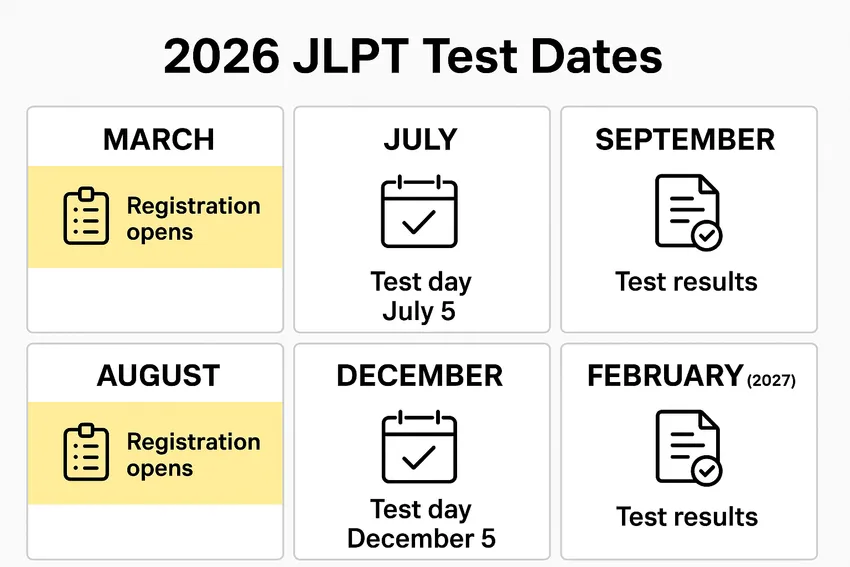
Note: You may not receive your July results before the registration for the December test closes.
Test Fees by Country/Region
JLPT fees vary significantly depending on where you take the test:
Japan:
- All levels (N5-N1): ¥7,500 (approximately $50-60 USD)
- Payment via credit card, bank transfer, or convenience store
United States:
- All levels (N5-N1): $100-120 USD
- Same fee regardless of level
- Only December session available (no July test)
India:
- N5: ₹1,558 (approximately $19 USD)
- N4: ₹1,770
- N3: ₹1,888
- N2: ₹2,006
- N1: ₹2,142
- Fees include 18% GST and payment gateway charges
United Kingdom:
- All levels: £85-100
Europe (varies by country):
- Germany: €70-90
- France: €75-85
- Belgium: €75
Other Asian countries:
- Philippines: ₱1,100-1,500
- China: ¥450-550 CNY
- South Korea: ₩40,000-50,000
- Indonesia: IDR 140,000-250,000
Australia/New Zealand:
- Australia: AUD $85-95
- New Zealand: NZD $90-100
Important notes about fees:
- Fees are non-refundable once registration is complete
- You cannot change your level after payment
- Some countries charge the same for all levels, others use tiered pricing
- Additional costs may include certificate copies (if you need duplicates later)
- Note: Fees listed are based on 2025 rates and may be subject to change in 2026
Where Tests Are Administered Globally
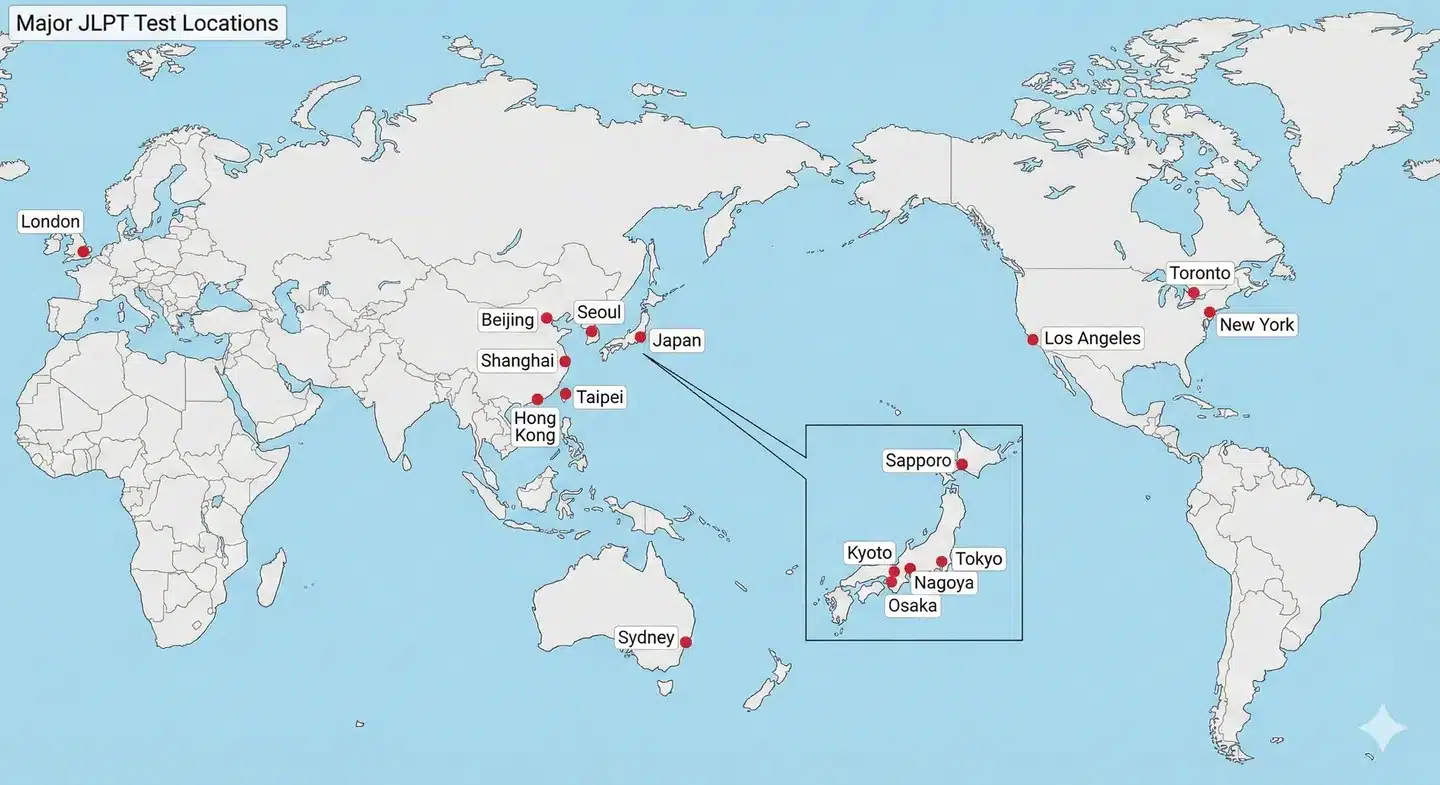
The JLPT is offered in over 90 countries and 300+ cities worldwide, making it one of the most accessible language proficiency tests.
Major test locations include:
Asia: Tokyo, Osaka, Kyoto (Japan); Beijing, Shanghai (China); Seoul, Busan (South Korea); Bangkok (Thailand); Manila (Philippines); Singapore; Kuala Lumpur (Malaysia); Jakarta (Indonesia); Hanoi, Ho Chi Minh City (Vietnam)
South Asia: New Delhi, Mumbai, Chennai, Bengaluru, Kolkata, Pune (India); Dhaka (Bangladesh); Kathmandu (Nepal)
North America: Los Angeles, New York, Chicago, San Francisco, Seattle, Boston, Washington D.C., Houston (USA); Toronto, Vancouver (Canada)
Europe: London (UK); Paris (France); Berlin, Munich (Germany); Rome (Italy); Madrid (Spain); Amsterdam (Netherlands); Brussels (Belgium)
Australia/Oceania: Sydney, Melbourne, Brisbane (Australia); Auckland (New Zealand)
Latin America: São Paulo (Brazil); Mexico City (Mexico); Buenos Aires (Argentina)
Africa: Johannesburg (South Africa); Cairo (Egypt); Nairobi (Kenya)
How to find your nearest test center:
- Visit the official JLPT website: www.jlpt.jp/e/
- Click on “Test Site” or “Overseas Test Sites”
- Select your country from the list
- You’ll be directed to your local JLPT administrator’s website with specific location details
Final registration tips:
- ✅ Register as soon as the portal opens—don’t wait
- ✅ Use your legal name exactly as it appears on your photo ID
- ✅ Double-check your email address—this is how you’ll receive important updates
- ✅ Save all confirmation emails and your application number
- ✅ Print your test voucher as soon as it’s available
- ✅ Arrive at the test center 30-45 minutes early on test day
- ❌ Don’t assume seats will still be available at the deadline
- ❌ Don’t register for multiple levels (you can only take one per session)
- ❌ Don’t expect refunds if you change your mind or can’t attend


 Loading ...