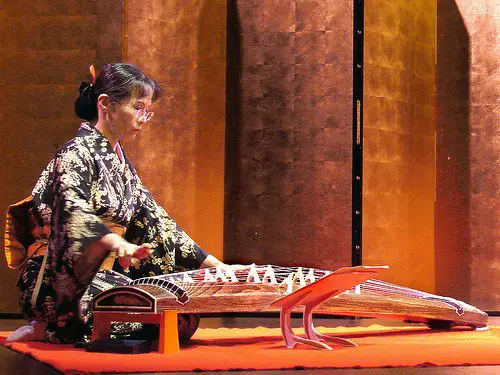
Koto - not only is it a musical instrument, it's also a pretty bad ass nominalizer.
This is the second part of a two part series on nominalizers. In the first part, we covered the nominalizer の. If you missed that part, I encourage you to go back and read about the nominalizer の.
Last week, I talked about the wonders of の and all it’s confusing exceptions. Well, hold on to your N4 Grammar book because now we are about to dive into the wonderful world of exceptions for こと.
There are some times when you must use こと instead of の.
1) verbs that involve talking, communicating, deciding, believing, or thinking about
There are several verbs that just sound more natural with こと. If you use の will you still be understood? Well, yes, but it is slightly unnatural. The main verbs that this is a problem for are 話す, やくそくする, 教える, 決める, 考える, and 信じる. That’s the major ones to worry about at least. I good way to think of it is, is it being communicated orごめん decided on? Then use こと.
Let’s look at some examples:




知らない ことを 話さないで ください。(Don’t talk about what you don’t know about.)
パーティにくる ことを やくそく する。 (I promise to go to the party.)
妻は ありがとう という ことを 私に 教えた。(My wife taught me to say ‘thank you’.)
NOTE: Not HOW to say thank you
夏休みに タイに 行く ことに 決めた。 (I decided to go to Thailand for summer vacation.)
日本で 働く ことを 考える。(I’m thinking about working in Japan.)
私は 飛べる ことを 信じる。 (I believe I can fly.)
2) Must use こと before any form of です EXCEPT for if the subject is 私.
The nominalizer こと is always used before any form of です like だ、だった、でした、でしょう、etc…
Even negative forms too like じゃない、ではない、etc… Let’s look at a quick example.
彼のゆめは 医者に なることだ。 (His dream is to become a doctor.)
Where it gets weird is when the subject is 私. I have to admit it’s a bit strange. Let’s look at a quick example:
私は、忙しい けれど 行きたい のだ。 (I’d like to go, but I’m busy.)
3) Set phrases that use こと
There are also some set phrases that we used to express different things that require こと as well. For example,
Talking about experience (the Japanese equivalent to present perfect.)
東京に 行った ことが ある。 (I’ve been to Tokyo.)
なっとうを 食べた ことが ない。(I haven’t eaten natto.)
Talking about the ability to do something
英語を 話す ことが できる。 same as 英語が 話せる。 (I can speak English.)
この歌を 歌う ことが できる。 same as この歌を 歌える。(I can sing this song.)
3) Written vs. Spoken Japanese
In general, こと is used more often in written Japanese, whereas の is used more often in spoken Japanese. I’ve been told by native speakers that こと is a little more formal or serious sounding. So, when writing use こと, when speaking use の.
Action Steps
1) What is the craziest thing you have experienced?
2) Spring vacation and Golden Week are coming soon. Did you decide to go anywhere?
Let me know in the comments below and try to use こと.
Image by US Army, available under the Creative Commons 2.0 Generic License


 Loading ...
I thought “present perfect” had to use the past tense form of the verb as it does in English?
Shouldn’t 東京に 行く ことが ある be 東京に行ったことがある, and なっとうを 食べる ことが ない be なっとうを食べたことがない?
My example:
きゅうしゅにいったことがないけど、ある日あれに行きたい。
今年、ゴールデンウィークのために家族と一緒に愛媛県の博物館へ行った。
ことし、ごーるでんうぃーくのためにかぞくといっしょにえひめけんのはくぶつかんへいった。
For Golden Week this year I went with my family to the museum in Ehime prefecture.
Good catch Geckomayhem!
You can actually say 東京に 行く ことが ある with the verb in the present tense to mean something like “I go to Tokyo regularly.” but, not for experiences. For experiences we do need to use the past tense. ごめん!
Your first sentence is perfect.
The second sentence we would actually just use に instead of のために. のために has the meaning similar to ‘for the purpose of~’, although it is sometimes translated as just ‘for’. You definitely have to be careful, there are about 4 or 5 different translations for ‘for’ in Japanese. It’s hard to keep them all straight!
The corrected sentence would be:
今年、ゴールデンウィークに家族と一緒に愛媛県の博物館へ行った. (checked by a native speaker)
Thanks for the correction and the comment Geckomayhem!